
Charles Darwin Perfectly Expresses the Agnostic Dilemma
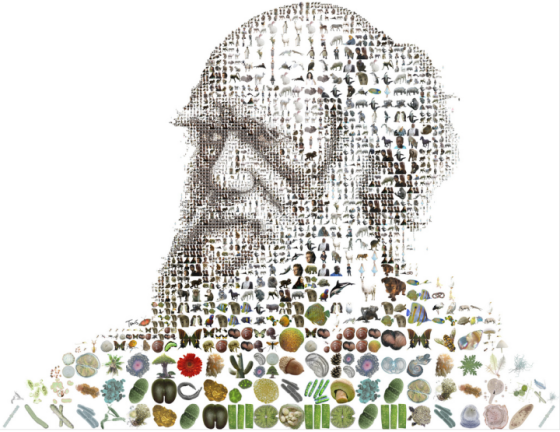
Mosaic image of Charles Darwin by illustrator Charis Tsevis. Click image for link.
Charles Darwin perfectly expresses the agnostic dilemma (from The Scottish Review, April 1888):
“The religious doctrine on which Mr. Darwin’s utterances have been the most explicit, is that of the existence of God. On this he writes: ‘What my own views may be is a question of no consequence to any one but myself. But as you ask, I may state that my judgment often fluctuates…. In my most extreme fluctuations I have never been an atheist, in the sense of denying the existence of God. I think that generally (and more and more as I grow older), but not always, that an Agnostic would be the more correct description of my state of mind.’ This was written in 1879. In 1873 he wrote:
“‘I may say that the impossibility of conceiving that this grand and wondrous universe, with our conscious selves, arose through chance, seems to me the chief argument for the existence of God; but whether this is an argument of real value, I have never been able to decide. I am aware that if we admit a First Cause, the mind still craves to know whence it came, and how it arose. Nor can I overlook the difficulty from the immense amount of suffering throughout the world. I am, also, induced to defer to a certain extent to the judgment of the many able men who have fully believed in God; but here again I see how poor an argument this is. The safest conclusion seems to me that the whole subject is beyond the scope of man’s intellect; but man can do his duty.’
“Three years later he wrote:
“‘Another source of conviction in the existence of God, connected with the reason, and not with the feelings, impresses me as having much more weight [than the argument “drawn from the deep inward convictions and feelings which are experienced by most persons.”] This follows from the extreme difficulty, or rather impossibility of conceiving this immense and wonderful universe, including man with his capacity of looking far backwards and far into futurity, as the result of blind chance or necessity. When thus reflecting I feel compelled to look to a First Cause having an intelligent mind in some degree analogous to that of man; and I deserve to be called a Theist. This conclusion was strong in my mind about the time, as far as I can remember, when I wrote The Origin of Species; and it is since that time that it has very gradually, with many fluctuations, become weaker. But then arises the doubt, can the mind of man, which has, as I fully believe, been developed from a mind as low as that possessed by the lowest animals, be trusted when it draws such grand conclusions if I cannot pretend to throw the least light on such abstruse problems. The mystery of the beginning of all things is insoluble by us; and I for one must be content to remain an Agnostic.’
“These passages are sufficiently explicit to show the attitude which their author assumed towards the greatest of all problems. There can be little doubt that in this matter Mr. Darwin is best described by the term he chose for himself—an Agnostic. But his agnosticism was not aggressive. It was reverent and not without a measure of hope and trust—the hope and trust of one who, wearied with his gropings amid the dark, and though not able entirely to relinquish his quest, is yet content to wait till the light appear.”