
“If I am Sophocles, I am not mad, and if I am mad, I am not Sophocles.”
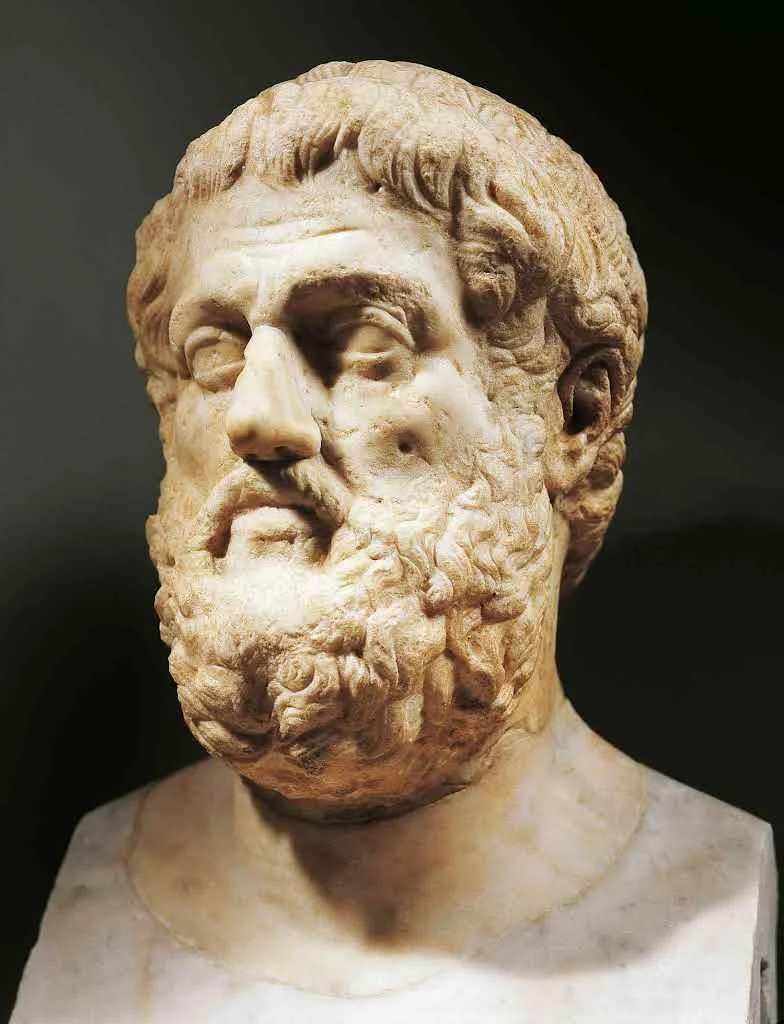
From Sophocles: A Mythic Life:
“The most celebrated story of all occurs shortly before Sophocles’ death at the age of ninety. The playwright’s son Iophon took him to court, claiming that his father was too doddering to manage his financial affairs. To prove his sanity, the poet recited a portion of Oedipus at Colonus, which he was composing at the time.”
Classicist and lexicographer William Smith, in A Smaller History of Greece from the Earliest Times to the Roman Conquest (1909):
“Sophocles, the younger rival and immediate successor of Aeschylus in the tragic art, was born at Colonus, a village about a mile from Athens, in B.C. 495. We have already adverted to his wresting the tragic prize from Aeschylus in 468, from which time he seems to have retained the almost undisputed possession of the Athenian stage, until a young but formidable rival arose in the person of Euripides. The close of his life was troubled with family dissensions. Iophon, his son by an Athenian wife, and therefore his legitimate heir, was jealous of the affection manifested by his father for his grandson Sophocles, the offspring of another son, Ariston, whom he had had by a Sicyonian woman. Fearing lest his father should bestow a great part of his property upon his favourite [son Ariston], Iophon summoned him before the Phratores, or tribesmen, on the ground that his mind was affected. The old man’s only reply was—‘If I am Sophocles I am not beside myself; and if I am beside myself I am not Sophocles.’ Then taking up his Oedipus at Colonus, which he had lately written, but had not yet brought out, he read from it a beautiful passage, with which the judges were so struck that they at once dismissed the case. He died shortly afterwards, in B.C. 406, in his 90th year. As a poet Sophocles is universally allowed to have brought the drama to the greatest perfection of which it is susceptible. His plays stand in the just medium between the sublime but unregulated flights of Aeschylus, and the too familiar scenes and rhetorical declamations of Euripides. His plots are worked up with more skill and care than the plots of either of his great rivals. Sophocles added the last improvement to the form of the drama by the introduction of a third actor; a change which greatly enlarged the scope of the action. The improvement was so obvious that it was adopted by Aeschylus in his later plays; but the number of three actors seems to have been seldom or never exceeded.”
https://www.bartleby.com/lit-hub/familiar-quotations/8483-sopholes-496-bc-406-bc-john-bartlett/%20
It is said that Iophon accused his father before the court of the phratores of being incapable of managing his affairs, so that he might gain the guardianship of his father's fortune. Sophocles replied to this charge by reading the chorus of the Oedipus at Colonus (688 ff.), which he was currently writing. The piece so proved that he was still in possession of all his mental faculties that he was acquitted.[1]
https://en.wikipedia.org/wiki/Iophon
https//www.gutenberg.org/cache/epub/2096/pg2096-images.html%20https://en.wikipedia.org/wiki/Cato_Maior_de_Senectute%20https://www.bartleby.com/lit-hub/hc/on-old-age/paras-129%20https://www.crtpesaro.it/Materiali/Latino/De%20Senectute.php%20https://www.excellence-in-literature.com/sophocles-biography/%20https://en.wikisource.org/wiki/Page:Tragedies_of_Sophocles_(Plumptre_1878).djvu/66%20.loebclassics.com/view/LCL020/1994/pb_LCL020.15.xml?print=%20peiraeuspubliclibrary.com/tragedy.htmlhttps://www.laphamsquarterly.org/contributors/sophocles
Some years afterwards, a marriage with Nicostrate, a free Athenian, gave him four sons, the eldest of whom, Iophon, was his father's legal heir. Ariston, however, had grown up, and a son was born to him, named after his grandfather, and so manifestly the darling of the old man's age that the legitimate sons feared he might be led to enrich him at their expense, and brought him before the Phratores, who in such cases exercised a kind of equitable jurisdiction, as needing guardianship. His answer was to read the wonderful chorus in which he has described the beauty and the glory of his native place, from the play of Oedipus at Colonos," as yet unfinished and unperformed, and to ask whether that gave any proof of a weakened or incapable intellect.[2] The usual order of the Courtwas disturbed by irrepressible emotion, and he left it as in the moments of his highest success he had left the theatre of Dionysos, amid loud clamours of applause. In the play itself we may trace, without too bold a conjecture, something both of the bitterness of these trials of his old age,[1] (Œd. Col., 1211–1238,) and of the reconciliation with the sons who had been so unfilial, (Œd. Col. 1280–1283.)[2]
The most celebrated story of all occurs shortly before Sophocles’ death at the age of ninety. The playwright’s son Iophon took him to court, claiming that his father was too doddering to manage his financial affairs. To prove his sanity, the poet recited a portion of Oedipus at Colonus, which he was composing at the time. “If I am Sophocles,” he is supposed to have said, “I am not senile, and if I am senile, I am not Sophocles.” The court was so moved by his recitation that the case was immediately dismissed.