
Johnny Cash Trivia
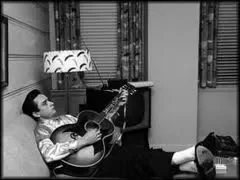
Born J.R. Cash in Kingsland, Arkansas, he was given the name “J.R.” because his parents could not agree on a name, only on initials. When he enlisted in the United States Air Force, the military would not accept initials as his name, so he adopted John R. Cash as his legal name. In 1955, when signing with Sun Records, he took Johnny Cash as his stage name.
As a U.S. Army code intercept operator for Soviet Army transmissions at Landsberg, Germany, he was the first radio operator to pick up the news of the death of Joseph Stalin.
Although Cash carefully cultivated a romantic outlaw image, he never served a prison sentence. Despite landing in jail seven times for misdemeanors, each stay lasted only a single night.
To this day, the United States Navy’s winter blue service uniform is referred to by sailors as “Johnny Cashes,” as the uniform’s shirt, tie, and trousers are solid black.
Cash relapsed into addiction after being administered painkillers for a serious abdominal injury in 1983 caused by an unusual incident in which he was kicked and wounded by an ostrich he kept on his farm.
Cash’s recording career and his general relationship with the Nashville establishment were at an all-time low in the 1980s. He realized that his record label of nearly 30 years, Columbia, was growing indifferent to him and was not properly marketing him (he was “invisible” during that time, as he said in his autobiography). Cash recorded an intentionally awful song to protest, a self-parody. “Chicken in Black” was about Cash’s brain being transplanted into a chicken. Ironically, the song turned out to be a larger commercial success than any of his other recent material. Nevertheless, he was hoping to kill the relationship with the label before they did, and it was not long after “Chicken in Black” that Columbia and Cash parted ways.
Cash learned upon researching his ancestry that he was of Scottish royal descent on his father’s side, traced back to Malcolm IV King of Scots (1153-1165). After the opportunity of meeting with since deceased Falkland, Fife laird, Major Michael Crichton-Stuart, he traced the Cash family tree to 11th-century Fife, Scotland. Scotland’s Cash Loch as well as portions of Fife bear the name of his family.