
Maurice Ravel Composes Bolèro
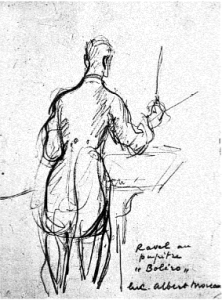
Ravel conducts l’Orchestre Lamoureux performing his Bolèro in 1932. Drawing by Luc-Albert Moreau. Click on image to play video.
Arbie Orenstein in Ravel: Man and Musician:
“Ravel had promised to complete a ballet for his good friend Ida Rubinstein. Madame Rubinstein requested an orchestral transcription of six pieces from Albeniz’s Iberia, and the initial sketches of ‘Rondeña’ were under way when, much to his vexation, Ravel was informed that the Spanish conductor Enrique Arbos had already orchestrated the pieces, and copyright laws forbade anyone else from transcribing them. Upon learning about the situation, Arbos graciously offered to renounce his exclusive copyright, and it appeared that the situation was saved. But now Ravel changed his mind and decided it would be more expeditious to orchestrate one of his own compositions. It turned out, finally, that he was to compose an original work. During a brief vacation in Saint-Jean-de-Luz, just before going for a morning swim with Gustave Samazeuilh, Ravel went to the piano and played a melody with one finger. ‘Don’t you think this theme has an insistent quality?’ he asked. ‘I’m going to try and repeat it a number of times without any development, gradually increasing the orchestra as best I can.’ Returning to Le Belvédère, he began work on this fresh project, which was entitled Fandango. The title was soon changed to Bolèro, and the ballet was completed in about five months. The new work was introduced and the Paris Opera by Madame Rubinstein’s troupe in November, 1928….Although well received, the Bolèro was soon to become incredibly popular, much to the surprise of its composer, who predicted that the leading symphony orchestras would refuse to program it.”