
Samuel Johnson: The Madness of William Collins
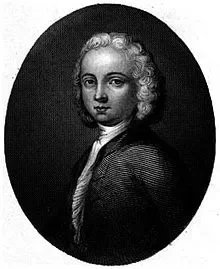
The English lyric poet William Collins (1721–1759).
How little can we venture to exult in any intellectual powers, or literary attainments, when we consider the condition of poor Collins! I knew him a few years ago, full of hopes and full of projects, versed in many languages, high in fancy, and strong in retention. This busy and forcible mind is now under the government of those who lately would not have been able to comprehend the least and most narrow of its designs.
Samuel Johnson, letter to the future Poet Laureate Thomas Warton, March 8, 1754
More on Johnson’s sympathy for Collins (from The National Magazine, 1853):
“The only production of any permanent interest from the pen of Johnson, bearing date in 1763, is a sketch of the poet Collins, furnished by him to the ‘Poetical Calendar,’ and afterward inserted, slightly enlarged, among the ‘Lives of the English Poets.’ That brief production bears strong indications of the author’s peculiar style and method of writing, being liberally loaded with reflections and sententious maxims of life. But it is chiefly remarkable for its tender sympathy toward the late suffering object of his memoirs. The writer, no doubt, saw much in Collins’s case to remind him of his own mental history; and probably while setting forth the influence of bodily languor in enervating, and at length dethroning, a noble intellect, he felt more than a speculative interest in the subject.
“Johnson had known Collins personally for a few years previous to his last and irrecoverable mental prostration; and when that sad event occurred, he deeply sympathized with his suffering friend. Writing to Dr. Warton soon after, he remarked : ‘How little can we venture to exult in any intellectual powers or literary attainments, when we consider the condition of poor Collins! I knew him a few years ago, full of hopes and full of projects, versed in many languages, high in fancy, and strong in retention. This busy and forcible mind is now under the government of tliose who lately would not have been able to comprehend the least and most narrow of its designs.’ Again, the next year, Johnson wrote : ”Poor, dear Collins! Let me know whether you think it would give him pleasure if I should write to him. I have often been near his state, and therefore have it in great commiseration.’ Of the nature of that condition to which Johnson supposed himself to ‘have often been near,’ he informs us in this sketch of his friend : ‘He languished under that depression of mind which enchains the faculties without destroying them, and leaves reason the knowledge of right without the power of pursuing it.’ And as to the origin of these morbid tendencies he adds: ‘His disorder was not alienation of mind, but general laxity and feebleness — a deficiency of vital rather than of intellectual powers.’ Such remarks, which are found frequently occurring in his writings, indicate both his interest in the general subject of mental disorders, and his extensive and accurate knowledge of their nature.
“A kindly feeling toward the mad poet, as a fellow author for bread, clearly manifests itself in this brief sketch; and the author is constantly prepared to explain away, or extenuate any of his seeming faults or foibles by references to the peculiarities of his circumstances. Truth required that it should be written, that Collins ‘designed many works, but accomplished very little;’ but this declaration is modified by the consideration immediately subjoined : ‘A man doubtful of his dinner, or trembling at his creditor, is not much disposed to abstract meditation or remote inquiries.’ In sketching his moral character, its imperfection is conceded; but this suggestive reflection is annexed:
“‘In a long continuance of poverty, and long habits of dissipation, it cannot be expected that any character should be exactly uniform; there is a degree of want by which the freedom of agency is almost destroyed; and long associations with fortuitous companions will at last relax the strictness of truth, and abate the fervor of sincerity.’ It can hardly be supposed that this was written without a lively recollection of the scenes of former times, when these things, in their most painful forms, were the circumstances in which Johnson was living, suffering, and faintly hoping for changes that now had occurred. Nor let our reader think that the time has passed when literature is so poorly rewarded. The history of some of our own contemporaries will unfold a chapter as full of anxiety and privation as any of the times of Johnson. When will a better day dawn? When true merit will be appreciated and its labors rewarded, although fame may not have heralded its approach.”